
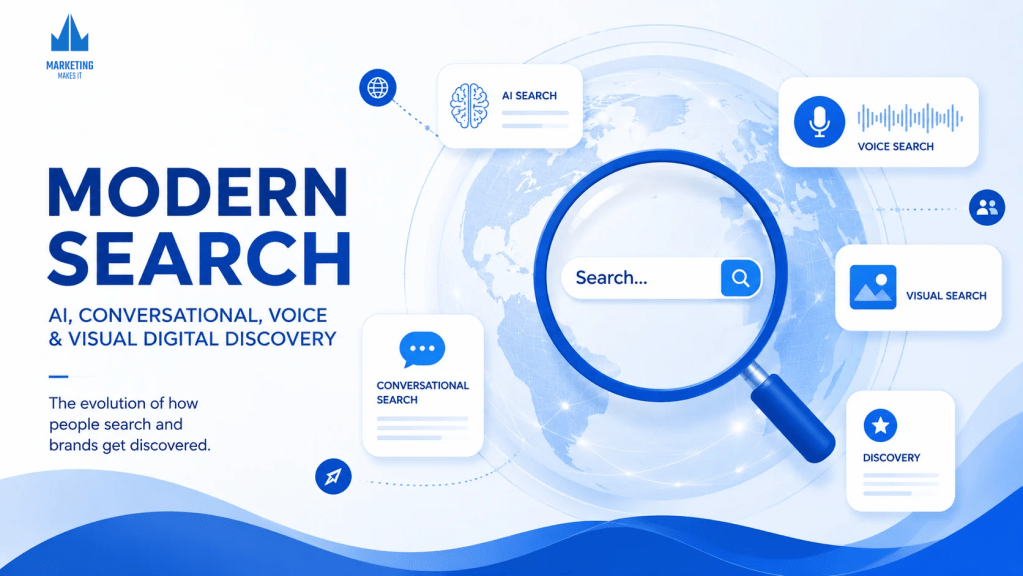
A few years ago, searching for people online meant entering keywords into a search engine and scrolling through links. Now, search goes beyond typing.
Advancements in tech and AI have transformed search. People can now find information by taking a screenshot, asking AI detailed questions, speaking to voice assistants, or discovering through social media—often before using a search engine.
That’s the new face of search for you. It has become conversational, visual, multimodal and increasingly AI-driven.
The shift from traditional search to multimodal search has already happened. The way people perceive and approach search has also evolved. They no longer rely on just typing keywords; now they search through conversations, voice commands and the most popular of all, the go-to of this era, AI-powered search. All this has made the search a whole experience in itself that is interactive, intuitive and everywhere.
So, the question is what’s in it for marketers. Well, let’s find out through this blog how marketers can leverage the full potential of modern search.
The Shift in Search: Redefining Digital Discovery
We live in a world where everything is just a click away, or rather, now a conversation away or a voice command away. The way people seek information is no longer limited to search engines; over the years, the search horizon has expanded, and so have the ways people discover, consume and interact online.
Today’s search looks and feels completely different. People search the way that feels more convenient, natural and exclusive. Gone are the days when the only option to get information was a text-based search. But now with multiple search options to choose from, users find answers faster, more interactive and tailored as per their search habits. Through the integration of AI and machine learning, search has become far more intelligent and intuitive.
Systems can now decode patterns and preferences through user behaviour in real time. This allows platforms to often deliver exactly what you want, even before you complete a search or prompt.
The journey of Search Evolution
- Keyword – Search: The conventional method focused on keywords and phrases related to the search topic to display results.
- Semantic Search: Understands context, meaning or user intent.
- Voice Search: spoken search with the help of voice assistants.
- Conversational Search: Searching through complete questions just like a natural conversation.
- Visual search: Searching through visual inputs like images or screenshots.
- AI Driven Search: Search that predicts and personalises results through user behaviour.
- Multimodal Search: A combination of text, voice, visual and AI in one search experience.
Voice and Visual Search: Search that Sees and Hears
One of the earliest shifts in modern search came when it started speaking and searching through visuals instead of just typing away the query. What once was a text search slowly evolved into a more convenient and natural form of search through voice search, images, screenshots and camera-based discovery.
Voice Search
Ever searched for something while you are tied up doing some tasks like driving, cooking or multitasking without touching your screen. That’s the kind of convenience voice search has to offer to modern discovery. And now that these voice assistants are powered by AI, they offer far more conversational and customised experiences.
With rapid innovation in smartphones, smart speakers, and wearable devices, voiceless interaction has become a seamless part of everyday search queries. And now that AI is integrated into search assistants, it has become much easier to understand intent and predict prompts more accurately than ever before.
Optimising for Voice Search
- Optimise content for natural and conversational queries.
- Focus on long-tail keywords and question-based searches.
- Improve local SEO for “near me” kind of voice searches.
- Create precise and direct answers for AI-featured snippet answers.
- Ensure websites support all kinds of screen sizes and have a fast loading speed.
Visual Search
Spotted an outfit, product or place you like, snap a picture and search it instantly. That’s how visual search is redefining discovery today. Visual search allows users to discover information through images, screenshots and camera inputs. Powered by AI and image recognition technology, platforms like Pinterest and Google Lens are transforming how users explore products or come across them online.
Optimising for Visual Search
- Use high-quality visual content.
- Optimise image alt text, file names and metadata.
- Create visually searchable product and brand assets.
- Focus on the mobile first visual experience.
- Leverage platforms like Google Lens and Pinterest search.
Conversational and AI Search: Search That Talks Back
Conversational Search
We’ve all been there, asking Search engines something like, “Hey, can you suggest a good restaurant nearby with a cozy vibe? Instead of typing keywords into a search bar. Hassle-free, isn’t it? This shift itself reflects how search has become conversational and human-like.
And now that these search engines are powered by AI and machine learning, conversational search has transformed discovery into a more predictive and personalised experience through natural language queries.
Optimising for Conversational
- Optimise content for natural conversational language queries.
- Focus on question-based long tail queries.
- Create concise and answer-focused content.
- Structure content around user intent and context.
AI – Driven Search
Have you noticed how platforms already see, to know what you’re looking for, even before you fully finish searching, or how some things that you recently showed interest in suddenly start appearing across your feed or search suggestions? That’s not a coincidence. It’s how AI-driven search analyses user behaviour, interests and patterns to deliver a more tailored discovery experience.
Optimising for AI-driven Search
- Create content that directly answers user intent and queries.
- Focus on context and relevance of the topic.
- Build credibility through accurate and trustworthy content with facts, figures and authentic references.
- Optimise content structure for AI-powered search visibility.
- Regularly keep your content updated to keep it relevant and fresh.
Why Search is Becoming Multimodal
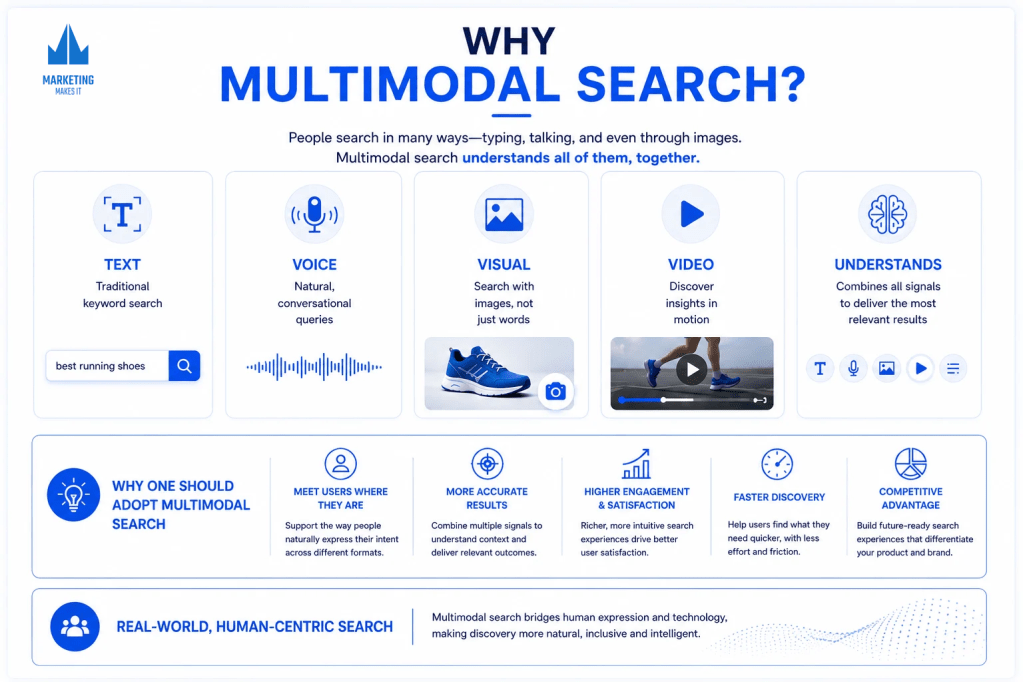
You see a product in a reel and instantly like it, next you do is take a screenshot to search it later, ask an AI tool for suggestions regarding it and finally, using a conversation search or AI tool, you search to find where to buy it from. Without even realising, search has now become a journey in itself that has to undergo various phases of search before users can finally proceed to buy it; that’s exactly how people go about search today.
Modern search is no longer about discovering products only through search engines; it has become dynamic, and users can come across products through any medium, be it a reel on Instagram, a TikTok video or a Google ad. Every user journey is different, so there’s no one fixed path to discovery.
As search becomes multimodal, user expectations and behaviours are also changing. People now expect more from discovery, they want it to be interactive, understanding and above all tuned to their interests so it exactly delivers what they want without having to waste time and effort in explaining every little detail.
How Marketers Can Stay Ahead
- Optimise content beyond SEO focused Keywords.
- Create content that is adaptable across search formats like voice, visual and AI search.
- Focus on understanding user intent and behaviour rather than just relying on keywords.
- Build a website and content that is adaptable across all screens and devices.
- Ensure your brand is visible across multiple search, AI-driven discovery platforms and on social platforms where your audience is most active.
- Create content that is interactive and feels customised to every user.
Staying Visible Beyond Search Bars
Search today is way more fluid than it ever was, with so many search formats and platforms available, users now stumble upon information in a more dynamic and unpredictable way than conventional search journeys allowed. Discovery no longer follows the same predefined rules; it is now being shaped by user behaviour, making search more adaptive, conversational, intent-driven, and personalised.
Users now move between AI tools, voice assistants, social platforms and visual discovery simultaneously before making any decision. Search is no longer a single action; that means brands need to be seamlessly present across platforms and formats throughout the entire search journey.
With continuous evolution in technology and trends, the best way, along with adapting to change, is to understand users and then build search ecosystems that fit their search habits.
Search has somehow become both fragmented and connected at the same time. Therefore, it is crucial to understand that it is not about just being found anymore, but about consistently showing up wherever discovery happens to stay relevant and remembered in this digital chaos.
 Marketing Makes It
Leave a comment