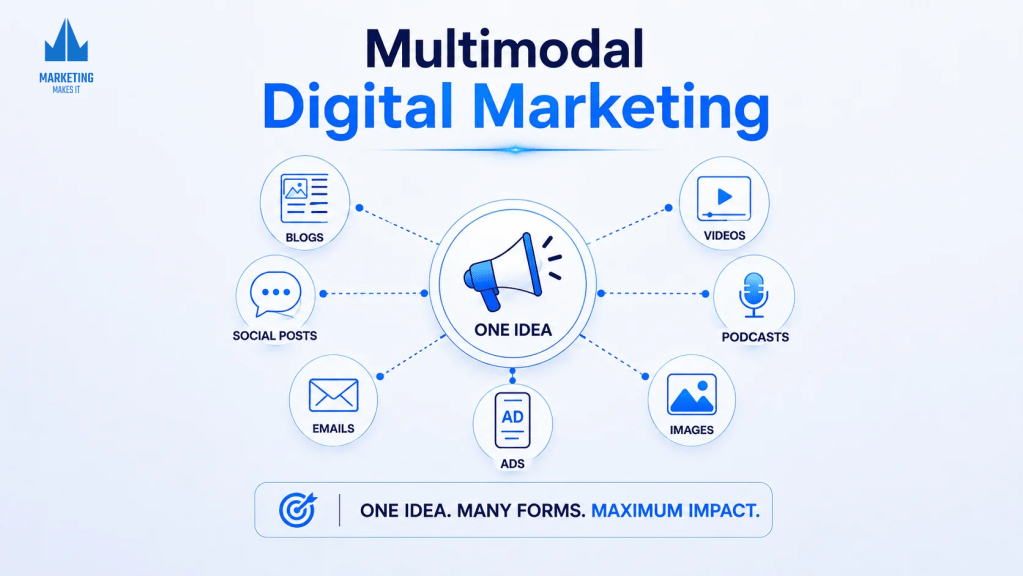
What if a single idea could follow your audience across channels they engage with, adapting its form to capture their attention? Content discovery today is no longer limited to a blog or a social post; it has moved beyond textual content, transforming into visuals, video, voice, and AI interactions. With the availability of multiple social media platforms like Facebook, Instagram, YouTube, LinkedIn, Google Search, and AI chatbots, audience interests have also become segmented based on platform preferences. And with so many platforms available, the format of content also needs to evolve into forms that are unique to these platforms; for instance, a reel works great for Instagram, a community post for Facebook, an SEO blog post for Google search, video content for YouTube, a thought insight post on LinkedIn, and conversational content for AI chatbots.
With every platform demanding its own format, managing a single piece of content across platforms can feel challenging, so how can one idea work effortlessly everywhere?
That’s when brands turn to multimodal digital marketing, which helps brands create a single messaging strategy where one piece of content is managed into different formats; for example, a blog post can be turned into a social post, video, or a visual carousel to expand the idea across channels. This is what makes multimodal digital marketing a powerful tool to enhance brand visibility through formats and socials that your audiences are drawn to.
Why Brands Need Multimodal Marketing Today More Than Ever
Today, your marketing strategy needs multiple doorways to reach your audience because multiple platforms have fragmented the attention of users. Today, within seconds, people switch platforms as they please. The way people come across content has drastically changed due to multiple options available. For marketers, this means that the same message needs to be conveyed across platforms and in multiple formats. For instance, a customer might discover your brand through an Instagram reel, later comes across an ad on YouTube, then the user digs into the brand on Google search, and finally asks an AI chatbot for recommendations before taking any action. This evolution of customer behaviour towards content consumption has pushed marketing teams to shift to multimodal strategies that allow one idea to adapt into various forms to cater to every interest on every platform.
Why Multimodal Marketing Strategies are No Longer Optional:
- Multi-platform Content Discovery: your audience no longer stays on one platform; they move across channels based on interests and intent. So, a single content format strategy is not relevant anymore.
- Platform-native content: Every platform has a unique native content format, and to engage on every platform, your content needs to adapt as per the format on every platform.
- Consistent Visibility: a multimodal marketing strategy ensures your message conveys the same intent while adapting itself according to each channel.
- Platform-specific intent: every platform shapes intent differently, such as Google search builds awareness, Instagram reels capture attention, and AI recommendations build trust.
- Audience Platform Preference: audiences choose platforms based on interests, habits, and intent.
- Better Brand Recall: When a message travels across platforms as a blog, post, video, or FAQs, it strengthens both visibility and credibility.
Role of Multimodal Marketing: Giving Ideas a New Outfit for Every Platform
In the digital world where attention is fleeting, it becomes important to keep your audience hooked to your brand exactly the way they like it, whether through a video, a post, a reel, or if their preference is, brands need to keep up with the interests to stay relevant. At its core, that’s exactly what multimodal marketing has to offer; it transforms one idea into many forms across channels without losing the intent of the idea. It connects fragmented interests into a brand experience that is cohesive, allowing people to encounter the same idea through every platform in different formats. So instead of working on content for every platform individually, a multimodal marketing strategy makes it a piece of cake to manage content on every platform by adapting content as per the nature of platforms, which in turn helps with making content last longer and increasing digital visibility.
How Does Multimodal Marketing Get Things Going:
- Cross-format content generation: converts ideas from text to visuals, audio, video, and AI interactive answers according to platform requirements.
- Multi-platform content distribution: ensures that a piece of content reaches the audience through search, socials, and AI platforms.
- Content repurposing: effectively modifies content into multiple formats for specific platforms without losing the meaning behind the idea.
- Search and AI-ready answers: structuring content for Google search, voice queries, and AI-generated answers.
- Messaging through visuals and videos: translating text-based content into captivating and engaging reels, carousels, and videos.
- Conversation content adaptation: turning content into FAQs and responses for AI chatbots and voice assistants.
- Audience behaviour alignment: repurposing content based on user behaviour across platforms.
AI in Multimodal Marketing: Same strategy with a smarter stylist behind every format
If multimodal marketing dresses your content for every platform, then AI helps the content style faster, smarter, and with greater ease. What once required human oversight in transforming content to make it platform-specific can now be managed by AI without human intervention. A blog can instantly be turned into a video, and customer queries can be turned into FAQs while preserving the core idea in every content form on every platform. What makes AI integration into multimodal marketing more beneficial is that it can personalise content as per customer behaviour, platform trends, and content performance, all by itself, making content more adaptable and scalable than before.
Why AI Levels Up Multimodal Marketing:
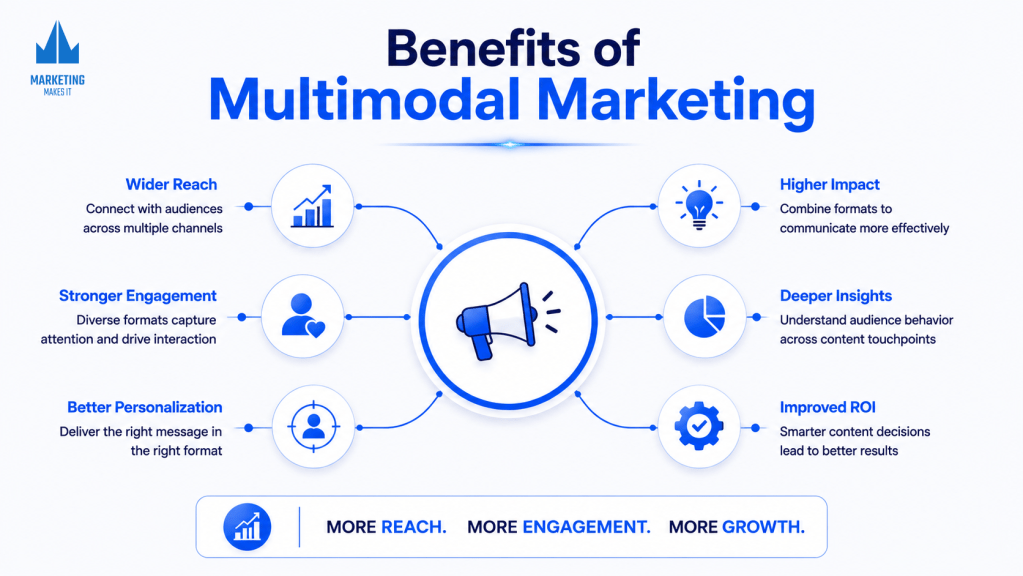
- Auto-generates multiple content formats: with the intervention of the team, AI is capable of creating a video, caption, and carousel directly from a single piece of content.
- Observes audience behaviour patterns: based on engagement data like clicks, views, and saves, it refines content accordingly.
- Personalises content: adjusts the tone of the message as per the user’s preference and intent for every platform.
- Structures content for AI-driven recommendations: transforms content into AI-ready summaries and voice search.
- Adapts content in real time: based on behavioural insights and trends, it automatically adjusts and adapts content in real time.
- Cross-platform insights: AI links different content formats and platforms to analyse engagement and to understand which messaging formats work best for them.
How to Integrate AI Multimodal Marketing into Your Workflow
Introducing AI-driven multimodal marketing into your workflow does not mean a complete strategy change; it’s about making improvements to your existing workflow by making it more adaptable and ready for multiple platform-specific content formats. Instead of spending hours on creating content for every platform, you need a system that does that for you in a single go, based on where your audience is and what it prefers. Nowadays, SEO alone is not enough because attention is very fragmented, so relying on search-based discovery limits visibility; therefore, you need a strategy that keeps you visible and relevant on every platform.
How to get started with AI-driven multimodal marketing:
- Start by choosing a single idea that aligns with your expertise as well as your target audience.
- Create a piece of content on that topic, like a blog, reel, or video, that is well researched as per the trends and customer preferences.
- Use AI to generate multiple format content: leverage AI to analyse and make use of the information to convert the content into various platform-specific formats like social posts, FAQs, AI-generated answers, and other suitable formats.
- Refine AI-generated content if required, as per your liking, to make it more natural.
- AI then suggests, based on behavioural data insights, which content format on which platform works best for you and where improvement is required.
- Using the insights strategically, decide which platforms to show up on initially based on where your audience is active and which formats suit your brand best.
With the right set-up, you can repurpose content and enhance visibility on various platforms through a single piece of content. Leveraging AI potential alongside multimodal marketing can work wonders for your visibility game.
So,What Does This All Mean For Marketers?
Looking at how things have evolved, one thing is clear: your audience isn’t waiting for you in one place. Therefore, content shouldn’t be limited to one platform and format as well. So, it is important for marketers to identify where their audience is fragmented and what kind of content they consume so that they can focus on the kind of content their target audience prefers. And to make workflow more efficient, AI helps craft content that is more adaptable and scalable across channels. For those who want to stay relevant and at the top of the visibility charts, the shift is about showing up in the right place with the right content that your audience actively engages with.
 Marketing Makes It
Leave a comment